
The Rooftop in Joppa and the Politics of Fear
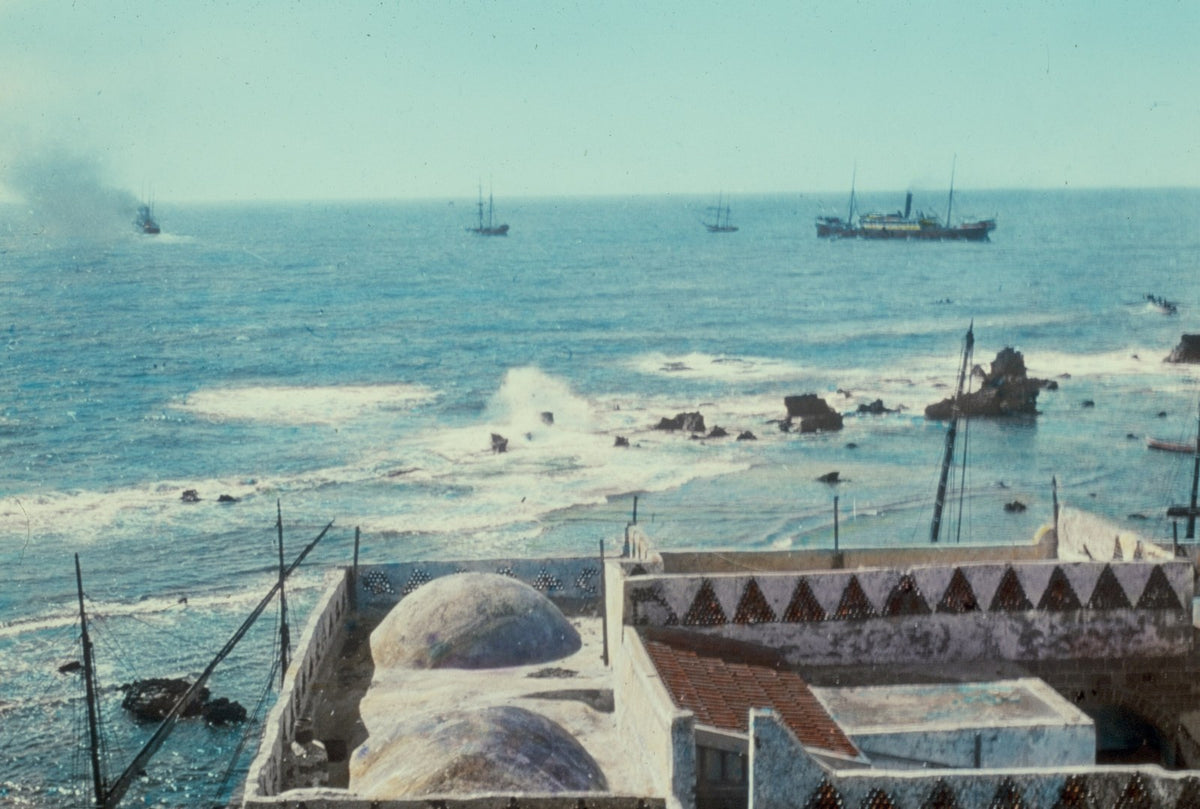
Pictured above: The sea at Jaffa, seen from the roof of the house shown to visitors as Simon the Tanner's, where Acts places Peter's vision. Colour slide, Matson Photograph Collection, Library of Congress, public domain, via Wikimedia Commons.
If we rewind the timeline before the clash at Antioch, the Book of Acts records that Peter was staying in the ancient port city of Joppa (modern-day Jaffa).
While praying on a sun-baked rooftop, Peter fell into a trance. He saw heaven open and a massive sheet lowered to the earth containing all kinds of non-kosher reptiles, birds, and animals. A voice commanded him: "Rise, Peter; kill and eat." When Peter refused on the grounds of strict Jewish purity laws, the voice responded with a sentence that would redefine the ancient world: "Do not call anything impure that God has made clean." (Acts 10:13-15).
The House of the Centurion
Peter didn't just have a vision; he immediately acted on it. He traveled up the coast to Caesarea Maritima and walked straight into the house of Cornelius, a Roman centurion. Entering the home of a Roman soldier was utterly forbidden by rabbinic purity standards, but Peter confidently told Cornelius that God had shown him he should not call any human being impure or unclean.
Peter ate with them, baptized them, and witnessed the Holy Spirit fall on uncircumcised pagans exactly as it had fallen on the Jewish apostles in Jerusalem. He even defended this radical table fellowship to the strict believers back in Judea.
Peter knew the theology. He had lived it. Which brings us to the agonizing question of Antioch.
The Geopolitics of Jerusalem
If Peter knew God had declared the Gentiles clean, why did he suddenly refuse to eat with them in Antioch when the delegation from James arrived?
The answer lies in the intense, terrifying geopolitical climate of 1st-century Judea. During this period, the Zealot movement was rapidly gaining steam. Anti-Roman sentiment was at a boiling point. In Jerusalem, any Jew who fraternized too closely with Gentiles—let alone ate with them in flagrant violation of traditional boundaries—was increasingly viewed not just as a religious liberal, but as a dangerous national traitor.
The believers in Jerusalem, led by James, were living in the epicenter of this pressure cooker. When conservative representatives from James traveled north to Antioch, they brought that intense Judean pressure with them.
Peter didn't change his theology in Antioch; he lost his nerve. He looked at the strict men from Jerusalem, calculated the political and social cost of what would happen if word got back to Judea that the lead apostle was eating like a Gentile, and he simply panicked.
This is exactly why Paul's rebuke in Galatians 2 is so blistering. Paul doesn't accuse Peter of bad theology; he accuses him of hypocrisy. The Greek word Paul uses is hypokrisis, which literally refers to an actor wearing a mask on a stage. Paul was screaming, in essence: "You know the truth! You had the vision in Joppa! You ate with Cornelius! You are acting a part right now to appease the circumcision faction, and you are dragging the rest of the church backward with you!"
The Takeaway
The early Apostles were not flawless marble statues; they were real men navigating an incredibly dangerous political world. Peter’s failure at Antioch is a profound reminder of how easily deep-seated social pressure and the fear of our own communities can override our deepest theological convictions. But it also shows the resilience of the early movement—it survived because men like Paul were willing to stand up and hold even their greatest leaders accountable to the truth of the Gospel.
Verse of the Day
πρὸ τοῦ γὰρ ἐλθεῖν τινας ἀπὸ Ἰακώβου μετὰ τῶν ἐθνῶν συνήσθιεν· ὅτε δὲ ἦλθον, ὑπέστελλεν καὶ ἀφώριζεν ἑαυτόν, φοβούμενος τοὺς ἐκ τῆς περιτομῆς.
"For before certain men came from James, he used to eat with the Gentiles. But when they arrived, he began to draw back and separate himself from the Gentiles because he was afraid of those who belonged to the circumcision group." Galatians 2:12
The Temple Mount Soil Team
Keepsakes from the same soil
Each piece carries authenticated soil recovered by the Temple Mount Sifting Project, sealed in Israel and matched to its own numbered Certificate of Authenticity.
 Covenant Soil Bracelet$39 Covenant Soil Bracelet$39 |
 The Pendant of Eternal Faith$69 The Pendant of Eternal Faith$69 |
 The Classic Gift Set$99 The Classic Gift Set$99 |
The Temple Mount Hourglass is open for Christmas presale
Ships by November 25, free shipping within the US.

