
The Great Schism: Why Paul and Barnabas Broke Up
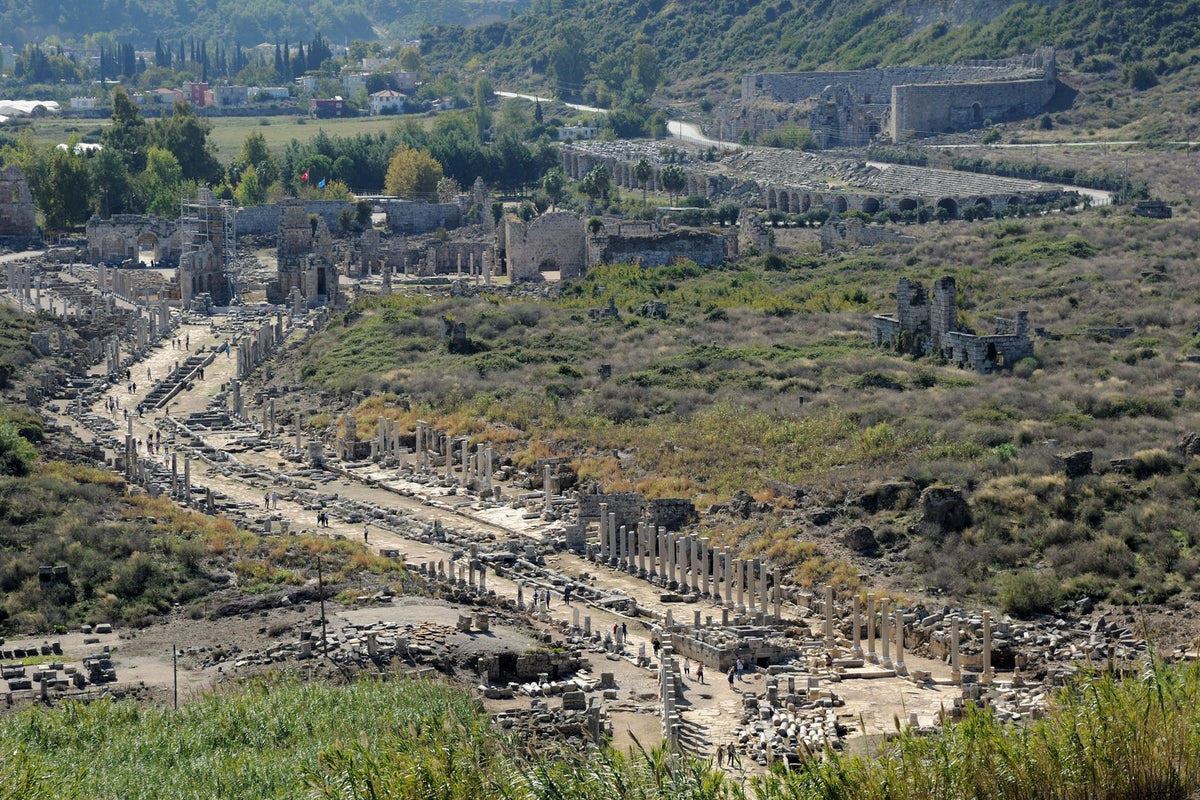
Pictured above: The ruins of Perga in Pamphylia, where John Mark turned back before the Taurus Mountains. Photograph by Saffron Blaze, CC BY-SA 3.0, via Wikimedia Commons. Licence.
Following the massive, historic victory at the Jerusalem Council, the early Church was finally unified. The theological crisis was averted, and Paul and Barnabas traveled back to Antioch as heroes, carrying the decree of James the Just.
Riding this wave of triumph, Paul turned to Barnabas and suggested they launch a second, even larger missionary journey to revisit all the cities where they had previously planted congregations.
Barnabas immediately agreed. But he had one condition: he wanted to bring his younger cousin, John Mark, along.
Paul flatly, furiously refused. What happened next tore the ultimate apostolic dream team entirely apart.
The Ghost of Pamphylia
To understand Paul's absolute refusal, we have to look back at their very first missionary journey.
Years earlier, Paul, Barnabas, and a young John Mark had sailed from Cyprus to the southern coast of modern-day Turkey, landing at the ancient river port of Perga in Pamphylia. At this point, the mission was about to turn inland, requiring them to cross the brutal, towering Taurus Mountains to reach the high plateau of Galatia.
In antiquity, the Taurus Mountains were notoriously dangerous. The roads were treacherous, the altitudes were freezing, and the passes were entirely controlled by violent brigands and highway robbers.
Faced with the terrifying reality of the Roman frontier, John Mark broke. Acts 13:13 records simply that Mark "left them and returned to Jerusalem."
To Paul, the zealous Pharisee who viewed his mission as an absolute spiritual war, this wasn't just a change of travel plans. This was military desertion in the face of the enemy.
The Paroxusmos
Now, preparing for the second journey, Barnabas—whose very name means "Son of Encouragement"—wanted to offer his young cousin grace and a second chance.
Paul looked at the immense dangers ahead and refused to take a liability into the field. He argued that a man who had deserted them once could not be trusted with the lives of the team or the survival of the churches.
The Book of Acts does not sugarcoat what happened next. The text says they had a "sharp disagreement" (in Greek, a paroxusmos). This isn't a polite difference of opinion. A paroxusmos is a violent, bitter, shouting provocation. The argument was so intense, and the fracture so deep, that these two spiritual giants—who had faced stoning, riots, and the Sanhedrin together—could not reconcile.
They split up. Barnabas took John Mark and sailed for Cyprus. Paul chose a new partner named Silas and marched overland toward Syria and Cilicia. It is incredibly easy to read this story and assume Paul was just being harsh, or that Barnabas was being too soft. But human nature shows something beautiful in the aftermath.
Because they split, the Jesus movement suddenly had two highly effective missionary teams covering twice the geographical ground instead of one.
Even more profoundly, Barnabas's grace actually worked. He took a broken, fearful young man and rebuilt him. We know this because decades later, when Paul is sitting in a cold, dark Roman dungeon awaiting execution, he writes his final letter to Timothy (2 Timothy 4:11). In his dying days, Paul asks for exactly one man to be brought to his side:
"Get Mark and bring him with you, because he is helpful to me in my ministry."
The deserter of Pamphylia eventually became the trusted rock of Paul's final days, and ultimately went on to write the Gospel of Mark.
The Takeaway
The early Church was not built by flawless superhumans; it was built by deeply flawed, passionate men who argued, fractured, and failed. The split between Paul and Barnabas is a stark reminder that God doesn't need perfect harmony to advance His kingdom. Sometimes, He uses our sharpest disagreements and deepest fractures to double the mission, and He uses the grace of encouragers to rebuild the people who abandon us in the mountains.
Verse of the Day
ἐγένετο δὲ παροξυσμός, ὥστε ἀποχωρισθῆναι αὐτοὺς ἀπ' ἀλλήλων, τόν τε Βαρναβᾶν παραλαβόντα τὸν Μᾶρκον ἐκπλεῦσαι εἰς Κύπρον· Παῦλος δὲ ἐπιλεξάμενος Σιλᾶν ἐξῆλθεν, παραδοθεὶς τῇ χάριτι τοῦ κυρίου ὑπὸ τῶν ἀδελφῶν.
"And there arose a sharp disagreement, so that they separated from each other. Barnabas took Mark with him and sailed away to Cyprus, but Paul chose Silas and departed, having been commended by the brothers to the grace of the Lord." Acts 15:39-40
The Temple Mount Soil Team
Keepsakes from the same soil
Each piece carries authenticated soil recovered by the Temple Mount Sifting Project, sealed in Israel and matched to its own numbered Certificate of Authenticity.
 Covenant Soil Bracelet$39 Covenant Soil Bracelet$39 |
 The Pendant of Eternal Faith$69 The Pendant of Eternal Faith$69 |
 The Classic Gift Set$99 The Classic Gift Set$99 |
The Temple Mount Hourglass is open for Christmas presale
Ships by November 25, free shipping within the US.