

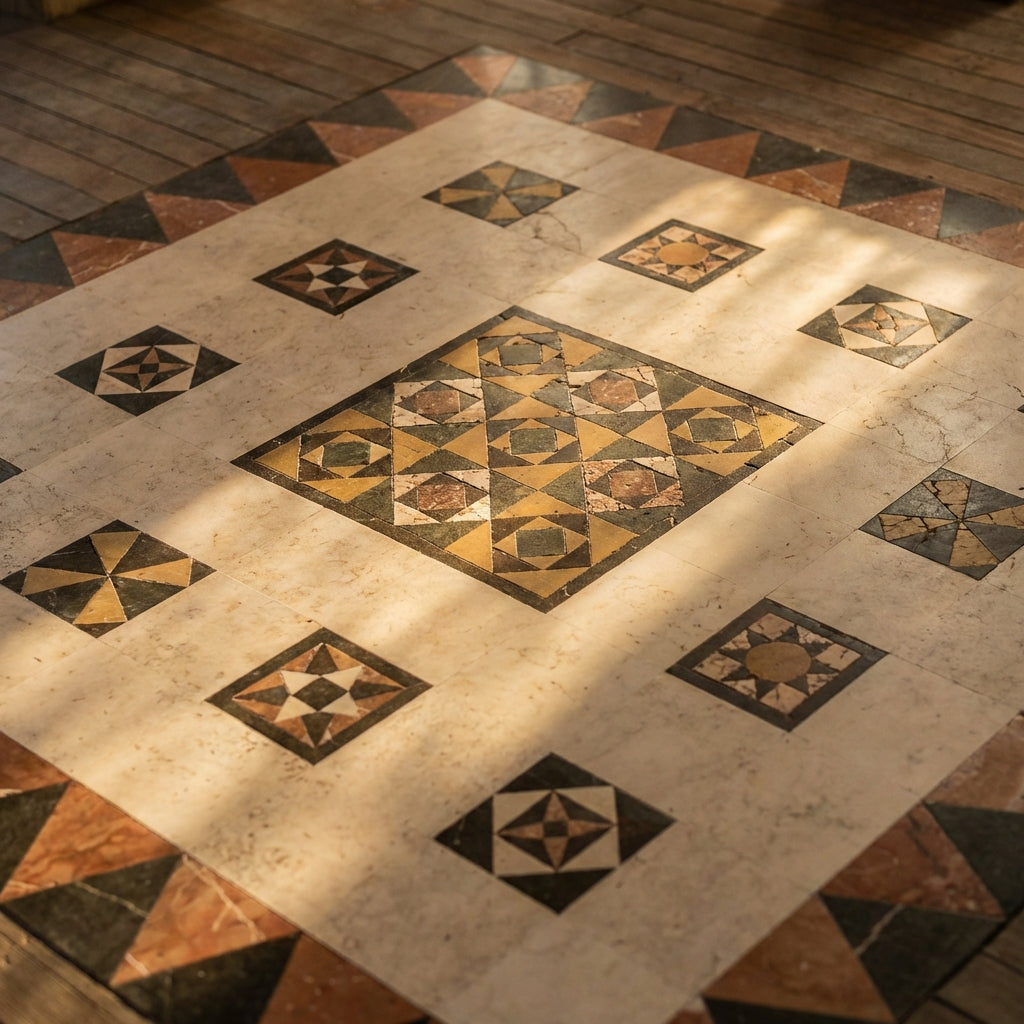
SOLVING THE TEMPLE PUZZLE: PHYSICAL EVIDENCE LINKS HERODIAN PALACE FLOORS TO THE TEMPLE MOUNT
When we read the Gospels, the setting is often just as important as the words spoken. We read that "Jesus was walking in the temple, in the colonnade of Solomon" (John 10:23), or we picture Him as He "sat down opposite the treasury and watched the people putting money into the offering box" (Mark 12:41). For centuries, these moments existed only in our imaginations. We could picture the events, but the stage itself (the very floor He walked on) was lost to history. Today, however, we can do more than imagine. Thanks to a remarkable combination of field archaeology and mathematics, we can now see the very patterns that Jesus saw.
The breakthrough began with a bold theory by archaeologist Assaf Avraham. He knew that the historian Josephus described the Temple courts as being "paved with all manner of stones," but for years, researchers weren't sure what that meant. Avraham suspected it referred to Opus Sectile: lavish, hand-cut geometric floors found in King Herod's other royal palaces. To test this, he did something extraordinary: he took actual stone tiles recovered from the Temple Mount soil and physically traveled to the ruins of Herod's palaces in Jericho, Masada, Herodium, and Caesarea.
In these ancient palaces, the original luxurious floors had been looted centuries ago, leaving behind only the "negative" impressions in the mortar where the tiles once sat. In a moment of archaeological revelation, Avraham placed the Temple Mount fragments into these ancient voids, and they fit perfectly. The dimensions, the angles, and the craftsmanship were identical. It was physical proof that the same royal architects who built Herod's private fortresses had also paved the public courts of the Temple in Jerusalem.
Once this connection was proven, the task of reconstructing the specific patterns fell to Frankie Snyder, a researcher with a background in mathematics. She realized that the debris wasn't random; it was a geometric puzzle. Snyder identified a unique "fingerprint" (a specific triangle with angles of roughly 52°, 64°, and 64°) that was a trademark of Herod's engineers. By using this "Herodian Gauge" and the Roman foot (approx. 29.6 cm) as a guide, she was able to mathematically predict the missing pieces, much like solving a jigsaw puzzle where the shape of the remaining pieces reveals the empty spaces. Because of this rigorous work, we have now reconstructed seven distinct floor patterns, meaning that when you see these designs today, you aren't looking at an artist's guess, but at a verified reconstruction of the floor Jesus walked on.
Learn More: Watch the reconstruction process in action: Biblical Archaeology From the Ground Down: Reconstructing the Temple Tile with Frankie Snyder
